
About this book
"In order to be truly free, must you act arbitrarily? If an event did not happen, could it have happened? Since there is evil, and God could have made the world without evil, did God fail to pick the best course? Grappling with such simple£yet still intriguing£puzzles, Leibniz was able to present attractively his new theories of the real and the phenomenal, freewill and determinism, and the relation between minds and bodies. Theodicy was Leibniz's only book-length work to be published in his lifetime, and for many years the work by which he was known to the world. Fully at home with the latest scientific advances, Leibniz ultimately rejected the new atomistic philosophies of Descartes, Gassendi, and Hobbes, and drew upon the old cosmology of Aristotelian scholasticism. There could be no conflict, he argued, between faith and reason, freedom and necessity, natural and divine law. Ingeniously defending his postulate of pre-established harmony, Leibniz made important advances in the precise analysis of concepts"--Publisher description.
- Theodicy
- Theism
- Free will and determinism
- Early works to 1800
- Early works
- Theodicy -- Early works to 1800
- Suffering, religious aspects
- Theodicy--early works to 1800
Books like Theodicy
More by Gottfried Wilhelm Leibniz
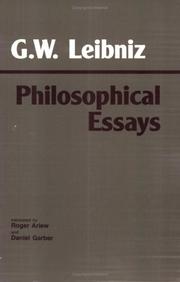 Philosophical essays1989
 Selections1718
 Discourse on metaphysics and other essays1991
 Sogenannte Monadologie und Principes de la nature et de la grace fondés en raison1728
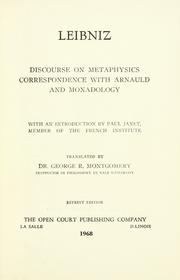 Discourse on metaphysics1902
 Nouveaux essais sur l'entendement humain1873
 Saemtliche Schriften Und Briefe1979
- The preface to Leibniz' Novissima SinicaThe preface to Leibniz' Novissima Sinica1957
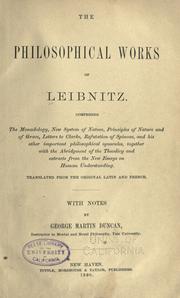 The philosophical works of Leibnitz ..1890
 Prose works1898
 Leibniz1910
 The labyrinth of the continuum2001