About this book
"Brad Inwood and James Warren The relationship of soul to body was one of the earliest and most persistent questions in ancient thought. It emerges in the Homeric poems, where the psuchē is a breath-like stuff that animates the human being until it departs at death for the underworld, leaving the corpse (sōma or nekros) behind. In the Odyssey these souls are found lurking wraith-like in the underworld until they are revitalized by a sacrifice of blood which gives them a temporary power to think and speak again. Among Pythagoreans and others, the soul lives imprisoned in the body until it is liberated at death, only to be reincarnated for a new life in a new body in accordance with its merits. Plato embraces this theory in several of his dialogues, but even this relatively autonomous substance is deeply affected by the conditions of the body it inhabits during life and the choices this embodied soul makes. Other early Greek thinkers regarded the soul as little more than the life force animating a body, a special kind of material stuff that accounts for the functions of a living animal but then disperses at death. Democritean atomism embraced this notion of soul, which was also common in the medical tradition.
- Soul
- Ancient Philosophy
- Âme
- Philosophie hellénistique
- Corps (philosophie)
Books like Body and Soul in Hellenistic Philosophy
More by Brad Inwood
 The Cambridge companion to the Stoics2003
 Stoicism2018
 Ethics and human action in early Stoicism1985
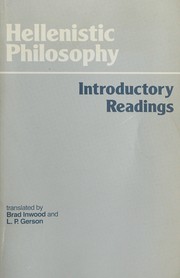 Hellenistic philosophy1988
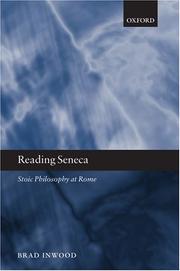 Reading Seneca2005
 The stoics reader2008
- AristotleAristotle2012
 Oxford studies in ancient philosophy2010
- Poem of EmpedoclesPoem of Empedocles2001
- Seneca : Selected Philosophical LettersSeneca : Selected Philosophical Letters2007
- Oxford Studies in Ancient Philosophy XXXVOxford Studies in Ancient Philosophy XXXV2008
- Oxford Studies in Ancient Philosophy, Volume 39Oxford Studies in Ancient Philosophy, Volume 392010