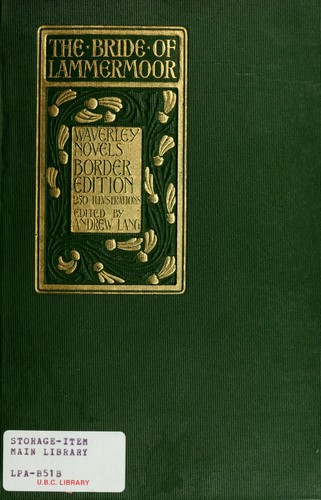
About this book
This new edition of The Bride of Lammermoor restores the action to 1703, before the Union of Scotland and England in 1707 rather than after it, which is where Scott's revisions of 1830 placed it. At last the sense of instability and of impermanence which permeates the novel makes sense, for what was to come in the impending revolution.
Love is doomed in this the most famous of Scott's plots. Edgar Ravenswood and Lucy Ashton are destroyed not just by the opposing political and religious allegiances of their families, but by the pervasive drive for power in a state where only power guarantees the ownership of real property.
Yet the politics are only an aspect of a predetermining fate, seen in the symbols of the bull, the tower, the violated maiden, the raven, in the image of the revenging ancestor, in the traditional prophecies and in the second sight of the village witches. There is only safety in Lucy's contemptus mundi, seen in her song, "Look thou not on Beauty's charming", and when she commits herself to Edgar she is lost.
- Fiction
- Women murderers
- Arranged marriage
- History
- Revenge
- Swindlers and swindling
- Translations into Russian
- Scotland, fiction
Books like The Bride of Lammermoor
More by Sir Walter Scott
 Ivanhoe1800
 Letters on demonology and witchcraft1830
 The lady of the lake1800
 The poetical works of Sir Walter Scott1800
 The Talisman1800
 The Antiquary1816
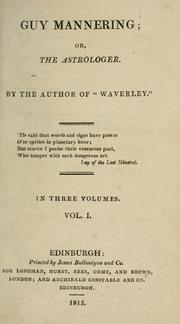 Guy Mannering1800
 Waverley novels1800
 Kenilworth1800
 The Evil Image1981
 The Norton Anthology of English Literature --Seventh Edition -- Volume 2A2000
 Tales of a grandfather1827