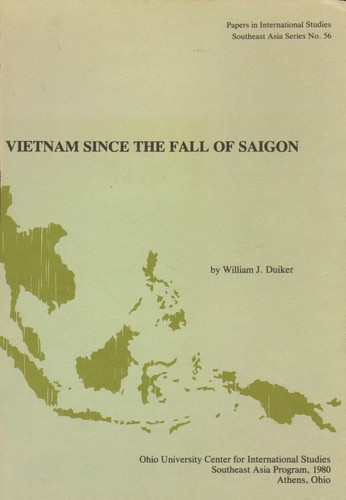
Vietnam since the fall of Saigon
Publicado por primera vez en 1980 · 261 páginas
Sobre este libro
When North Vietnamese troops occupied Saigon at the end of April 1975, their leaders in Hanoi faced the future with pride and confidence. Almost fifteen years later, the euphoria has given way to sober realism. Since the end of the war, the Communist regime has faced an almost uninterrupted series of difficulties including sluggish economic growth at home and a costly occupation of neighboring Cambodia. For the Vietnamese, the basic documents came from Lenin and Mao Tse-tung. The first task of the new rulers in South Vietnam was to fill the vacuum left by the virtual disintegration of the previous regime. Beyond the immediate problem of restoring law and order in the South, the primary problem for the new regime would be to set the economic sector back on its feet. The new regime also moved expeditiously to eliminate or at least reduce the "poisonous weeds" of Western bourgeois culture and plant the seeds of a new and beautiful socialist culture. The regime was taking the first tentative steps toward building socialism in the South while for the time being tolerating a significant degree of private enterprise in most sectors of the economy. - Publisher.
- History
- Politischer Wandel
- Vietnam, history
Libros como Vietnam since the fall of Saigon
Más de William J. Duiker
 HO CHI MINH2000
 World history1994
 Sacred war1995
 Contemporary world history2010
 The communist road to power in Vietnam1981
 Twentieth-century world history1999
 China and Vietnam1986
 The essential world history2002
 The Essential World History, Volume I2001
 Introduction to Vietnam1991
 World History Vol. II1997
- The Comintern and Vietnamese communismThe Comintern and Vietnamese communism1975