
The Character of Physical Law
Publicado por primera vez en 1965 · 173 páginas
Sobre este libro
"Richard Feynman is one of, if not the, most famous physicists of the latter half of the 20th century. In 1964, at Cornell University, he delivered the famous Messenger Lectures. This book, The Character of Physical Law, sprung from these lectures. In this classic work, Feynman explores the relationship between math and physics, describes the great conservation principles, the puzzle of symmetry in physical law, how to reconcile physical problems that yield infinite results with their manifestations in the natural world, and quantum mechanical views of nature. Feynman's accessible speech and conversational style comes through well in each essay; his simple pencil and paper drawings communicate complex ideas as if one were viewing them on a chalk board. This reissue features a foreword by Nobel Laureate Frank Wilczek, which situates the work within modern scholarship and describes why the book is still relevant today. Although he mentions areas where Feynman's theories need "updating," he points out that Feynman's unorthodox and brilliant way of thinking helped develop the general quantum electrodynamics theory, one of the most precise and accurate theories in physical science. Wilczek concludes with the assertion that this book represents Feynman at "the height of his powers, and that this "is the single best introduction to modern physics, altogether.""--
- Physics
- Addresses, essays, lectures
- Wetenschapsfilosofie
- Natuurwetten
- Histoire
- Physique
- Natuurkunde
- Gesetz
Libros como The Character of Physical Law
Más de Richard Phillips Feynman
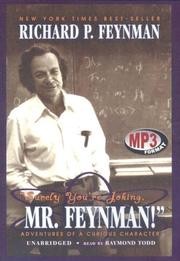 "Surely You're Joking, Mr. Feynman"1984
 Six Easy Pieces1994
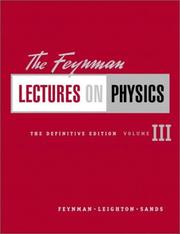 The Feynman Lectures on Physics1963
 The Pleasure of Finding Things Out1999
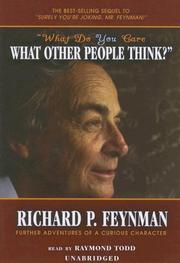 What Do You Care What Other People Think?1988
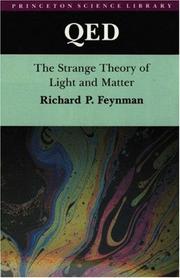 QED1985
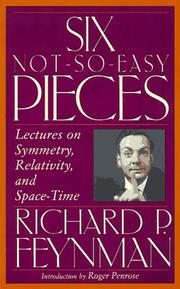 Six not-so-easy pieces1997
 The Meaning of It All1998
 The Feynman Lectures on Physics including Feynman's Tips on Physics2005
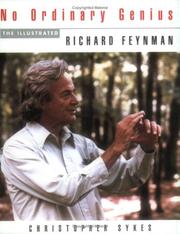 No Ordinary Genius1994
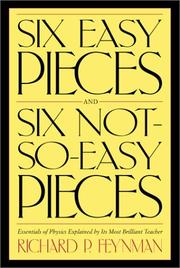 Six Easy Pieces, Six Not-So-Easy Pieces2001
 Feynman lectures on computation1996