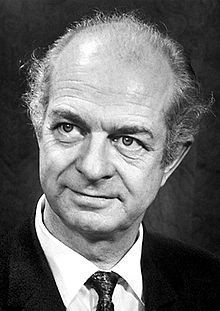
Linus Pauling
Nació 1901 · Murió 1994
De Portland, Oregon, United States · Nacionalidad: United States
Linus Carl Pauling FRS (28 de febrero de 1901 – 19 de agosto de 1994) fue un químico, bioquímico, ingeniero químico, activista por la paz, escritor y educador estadounidense. Publicó más de 1200 artículos y libros, de los cuales unos 850 trataban temas científicos. La revista New Scientist lo consideró uno de los 20 científicos más grandes de todos los tiempos, y en el año 2000 fue clasificado como el decimosexto científico más importante de la historia. Por su trabajo científico, Pauling recibió el Premio Nobel de Química en 1954, y por su activismo en favor de la paz, el Premio Nobel de la Paz en 1962. Es una de las cinco personas que han obtenido más de un Premio Nobel (las otras son Marie Curie, John Bardeen, Frederick Sanger y Karl Barry Sharpless). De entre ellas, es el único que ha recibido dos Premios Nobel individuales, y uno de los dos únicos en haber sido galardonados con Premios Nobel en campos distintos; el otro es Marie Curie.
Pauling fue uno de los fundadores de la química cuántica y de la biología molecular. Sus aportaciones a la teoría del enlace químico incluyen el concepto de hibridación orbital y la primera escala precisa de electronegatividades de los elementos. También trabajó en la estructura de las moléculas biológicas y demostró la importancia de la hélice alfa y de la lámina beta en la estructura secundaria de las proteínas. El enfoque de Pauling combinó métodos y resultados de la cristalografía de rayos X, la construcción de modelos moleculares y la química cuántica.
Citas
“If you want to have good ideas you must have many ideas. Most of them will be wrong, and what you have to learn is which ones to throw away.”
1990sEn inglés “I have something that I call my Golden Rule. It goes something like this: “Do unto others twenty-five percent better than you expect them to do unto you.” … The twenty-five percent is for error.”
1990sEn inglés “Only when I began studying chemical engineering at Oregon Agricultural College did I realize that I myself might discover something new about the nature of the world.”
1990sEn inglés
Citas de Wikiquote (CC BY-SA 4.0).
Los libros de Linus Pauling en orden
Los libros de Linus Pauling en el orden en que se publicaron, de The Structure of Line Spectra (1930) a Healing Cancer (2004).
- 1The Structure of Line Spectra
 The Structure of Line Spectra1930
- 2Introduction to Quantum Mechanics
 Introduction to Quantum Mechanics1935
- 3Introduction to Quantum Mechanicswith Applications to Chemis
 Introduction to Quantum Mechanicswith Applications to Chemistry1935
- 4Uniones Químicas Y La Estructura De Moléculas Y Cristales
 Uniones Químicas Y La Estructura De Moléculas Y Cristales1939
- 5Química General
 Química General1947
- 6Nature of the Chemical Bond
 Nature of the Chemical Bond1948
- 7College Chemistry
 College Chemistry1950
- 8College Chemistry, an Introductory Textbook of General ChemiCollege Chemistry, an Introductory Textbook of General Chemistry1951
- 9Molecular Structure and Biological Specificity
 Molecular Structure and Biological Specificity1957
- 10No More War!
 No More War!1958
- 11The Nature of the Chemical Bond and the Structure of Molecul
 The Nature of the Chemical Bond and the Structure of Molecules and Crystals: An Introduction to Mode1960
- 12Would Civilisation Survive a Nuclear War?Would Civilisation Survive a Nuclear War?1963
- 13Architecture of Molecules
 Architecture of Molecules1964
- 14La Ciencia Y El Futuro De La HumanidadLa Ciencia Y El Futuro De La Humanidad1970
- 15Vitamin C and the Common Cold
 Vitamin C and the Common Cold1970
- 16Chemistry
 Chemistry1975
- 17Scientists and ResponsibilityScientists and Responsibility1976
- 18Vitamin C, the Common Cold, & the Flu
 Vitamin C, the Common Cold, & the Flu1976
- 19Cómo vivir más y sentirse mejor
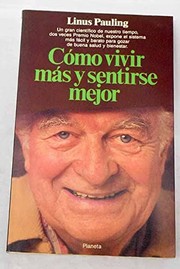 Cómo vivir más y sentirse mejor1986
- 20Linus Pauling
 Linus Pauling1989
- 21En Busca De La Paz
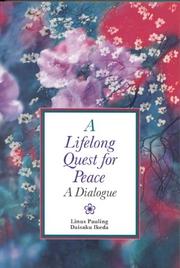 En Busca De La Paz1992
- 22Vitamin C & Cancer
 Vitamin C & Cancer2001
- 23Healing Cancer
 Healing Cancer2004
- 24The Chemical BondThe Chemical Bond