
Ruth Benedict
Nació 5 June 1887 · Murió 17 September 1948
De New York City, New York, United States · Nacionalidad: United States
Ruth Benedict (nacida el 5 de junio de 1887 en Nueva York, Estados Unidos; fallecida el 17 de septiembre de 1948 en la ciudad de Nueva York) fue una antropóloga estadounidense cuyas teorías ejercieron una profunda influencia en la antropología cultural, sobre todo en el ámbito de la cultura y la personalidad.
Benedict se graduó en el Vassar College en 1909, vivió un año en Europa y después se estableció en California, donde dio clases en colegios para niñas. En 1914 regresó a la ciudad de Nueva York.
Durante varios años Benedict buscó en vano una ocupación. En 1919 se matriculó en la New School for Social Research, donde la influencia de Elsie Clews Parsons y Alexander Goldenweiser la llevó a estudiar antropología con Franz Boas en la Universidad de Columbia. Se acercó a la disciplina desde una sólida formación humanística y, incluso después de involucrarse en el campo en la década de 1920, siguió escribiendo poesía bajo el seudónimo de Anne Singleton hasta comienzos de los años treinta. Desde el inicio de su carrera en las ciencias sociales concibió las culturas como construcciones totales formadas por elementos intelectuales, religiosos y estéticos. Obtuvo su doctorado en 1923 con una tesis sobre un tema omnipresente entre los indios norteamericanos, *The Concept of the Guardian Spirit in North America* (1923). En 1924 comenzó a impartir clases en Columbia.
Citas
“From the moment of his birth the customs into which [an individual] is born shape his experience and behavior. By the time he can talk, he is the little creature of his culture.”
Chapter 1En inglés “No man ever looks at the world with pristine eyes. He sees it edited by a definite set of customs and institutions and ways of thinking.”
Chapter 2En inglés “The tough-minded are content that differences should exist. They respect differences. Their goal is a world made safe for differences, where the United States may be American to the hilt without threatening the peace of the world, and France may be France, and Japan may be Japan on the same conditions.”
p. 15En inglés
Citas de Wikiquote (CC BY-SA 4.0).
Los libros de Ruth Benedict en orden
Los libros de Ruth Benedict en el orden en que se publicaron, de Scientific Papers (1922) a Pocket Guide for American Servicemen to the Cities of the Netherlands During World War II (2010).
- 1Scientific PapersScientific Papers1922
- 2Patterns of Culture
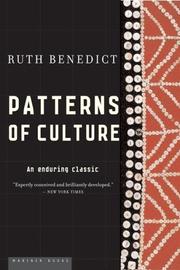 Patterns of Culture1934
- 3Zuni Mythology
 Zuni Mythology1935
- 4Race and Racism
 Race and Racism1942
- 5The Races of Mankind
 The Races of Mankind1943
- 6Bicycling
 Bicycling1944
- 7Race: Science and Politics
 Race: Science and Politics1945
- 8The Chrysanthemum and the Sword
 The Chrysanthemum and the Sword1946
- 9Patters of Culture
 Patters of Culture1949
- 10O'odham Creation & Related Events
 O'odham Creation & Related Events2001
- 11Pocket Guide for American Servicemen to the Cities of the NePocket Guide for American Servicemen to the Cities of the Netherlands During World War II2010
- 121. Chrysanthemum and the Sword, Patterns of Japanese Culture1. Chrysanthemum and the Sword, Patterns of Japanese Culture
- 13An Anthropologist at Work
 An Anthropologist at Work
- 14Continuities & Discontinuities in Cultural ConditioningContinuities & Discontinuities in Cultural Conditioning
- 15Krizantem Ve Kilic
 Krizantem Ve Kilic
- 16Le Chrysanthème et le sabre
 Le Chrysanthème et le sabre