
Amartya Sen
Naissance 3 November 1933
Originaire de Santiniketan, West Bengal, India · Nationalité : India · Écrit des essais et documents
Amartya Kumar Sen (né le 3 novembre 1933) est un économiste et philosophe éminent qui, depuis 1972, a enseigné et travaillé en Inde, au Royaume-Uni et aux États-Unis. Sen a apporté des contributions à l'économie du bien-être, à la théorie du choix social, à la justice économique et sociale, aux théories économiques des famines, ainsi qu'aux indicateurs permettant de mesurer le bien-être des citoyens des pays en développement.
Citations
“John Kenneth Galbraith doesn’t get enough praise. The Affluent Society is a great insight, and has become so much a part of our understanding of contemporary capitalism that we forget where it began. It’s like reading Hamlet and deciding it’s full of quotations.”
2000sEn anglais “Where is the railway station?” he asks me. “There,” I say, pointing at the post office, “and would you please post this letter for me on the way?” “Yes,” he says, determined to open the envelope and check whether it contains something valuable.
1970s, p. 332En anglais “Smith had no illusion that this would be easy to do, nor did he suffer from the delusion that such an exercise would, in any sense, be perfect. But he did have the conviction that the exercise could still be very useful, and the best should not be made into an enemy of the good.”
2010sEn anglais “What moves us, reasonably enough, is not the realization that the world falls short of being completely just – which few of us expect – but that there are clearly remediable injustices around us which we want to eliminate.”
The Idea of JusticeEn anglais “Given what can be achieved through intelligent and humane intervention, it is amazing how inactive and smug most societies are about the prevalence of the unshared burden of disability.”
2000sEn anglais
Citations de Wikiquote (CC BY-SA 4.0).
Les livres de Amartya Sen dans l'ordre
Les livres de Amartya Sen dans l'ordre de parution, de Choice of Techniques (1960) à Home in the World (2021).
- 1Choice of TechniquesChoice of Techniques1960
- 2Growth EconomicsGrowth Economics1970
- 3On Economic Inequality
 On Economic Inequality1973
- 4Poverty and Famines
 Poverty and Famines1981
- 5Choice, Welfare, and Measurement
 Choice, Welfare, and Measurement1982
- 6Resources, Values, and Development
 Resources, Values, and Development1984
- 7Commodities and Capabilities
 Commodities and Capabilities1985
- 8On Ethics and Economics
 On Ethics and Economics1987
- 9Inequality Reexamined
 Inequality Reexamined1992
- 10Nueva economía del bienestar
 Nueva economía del bienestar1995
- 11Human Rights and Asian Values
 Human Rights and Asian Values1997
- 12L' économie est une science morale
 L' économie est une science morale1999
- 13Reason Before Identity
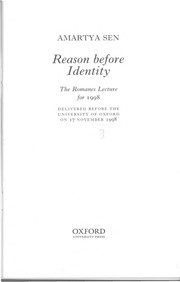 Reason Before Identity1999
- 14Un nouveau modèle économique
 Un nouveau modèle économique1999
- 15Repenser l'inégalité
 Repenser l'inégalité2000
- 16Rationality and Freedom
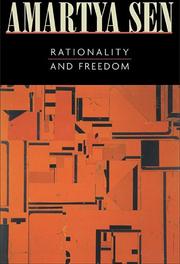 Rationality and Freedom2003
- 17Identity and Violence
 Identity and Violence2005
- 18The Argumentative Indian
 The Argumentative Indian2005
- 19The Idea of Justice
 The Idea of Justice2009
- 20Collective Choice and Social WelfareCollective Choice and Social Welfare2017
- 21Home in the World
 Home in the World2021
- 22Sobre Etica y EconomiaSobre Etica y Economia