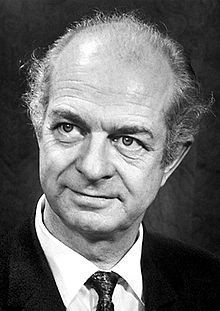
Linus Pauling
Naissance 1901 · Décès 1994
Linus Carl Pauling, FRS (28 février 1901 – 19 août 1994), fut un chimiste, biochimiste, ingénieur chimiste, militant pacifiste, auteur et éducateur américain. Il publia plus de 1 200 articles et ouvrages, dont environ 850 traitaient de sujets scientifiques. Le magazine New Scientist le considéra comme l'un des vingt plus grands scientifiques de tous les temps, et, en 2000, il fut classé au seizième rang des scientifiques les plus importants de l'histoire.
Pour ses travaux scientifiques, Pauling reçut le prix Nobel de chimie en 1954. Pour son engagement pacifiste, il obtint le prix Nobel de la paix en 1962. Il est l'une des cinq personnes à avoir remporté plus d'un prix Nobel, aux côtés de Marie Curie, John Bardeen, Frederick Sanger et Karl Barry Sharpless. Parmi eux, il est le seul à avoir reçu deux prix Nobel non partagés, et l'un des deux seuls, avec Marie Curie, à s'être vu décerner des prix Nobel dans des domaines différents.
Pauling fut l'un des fondateurs de la chimie quantique et de la biologie moléculaire. Ses contributions à la théorie de la liaison chimique comprennent le concept d'hybridation orbitalaire et la première échelle précise d'électronégativité des éléments. Il s'intéressa également à la structure des molécules biologiques et montra l'importance de l'hélice alpha et du feuillet bêta dans la structure secondaire des protéines. L'approche de Pauling associait les méthodes et les résultats de la cristallographie aux rayons X, de la construction de modèles moléculaires et de la chimie quantique.
Citations
“If you want to have good ideas you must have many ideas. Most of them will be wrong, and what you have to learn is which ones to throw away.”
1990sEn anglais “I have something that I call my Golden Rule. It goes something like this: "Do unto others twenty-five percent better than you expect them to do unto you." … The twenty-five percent is for error.”
1990sEn anglais “Only when I began studying chemical engineering at Oregon Agricultural College did I realize that I myself might discover something new about the nature of the world.”
1990sEn anglais
Citations de Wikiquote (CC BY-SA 4.0), choisies avec l'IA.
Les livres de Linus Pauling dans l'ordre
Les livres de Linus Pauling dans l'ordre de parution, de The Structure of Line Spectra (1930) à Introduction to Quantum Mechanicswith Applications to Chemistry (2018).
- 1The Structure of Line Spectra
 The Structure of Line Spectra1930
- 2Introduction to Quantum Mechanics
 Introduction to Quantum Mechanics1935
- 3The Nature of the Chemical Bond and the Structure of Molecul
 The Nature of the Chemical Bond and the Structure of Molecules and Crystals1939
- 4Chimie Générale
 Chimie Générale1947
- 5Nature of the Chemical Bond
 Nature of the Chemical Bond1948
- 6College Chemistry
 College Chemistry1950
- 7College Chemistry, an Introductory Textbook of General ChemiCollege Chemistry, an Introductory Textbook of General Chemistry1951
- 8Molecular Structure and Biological Specificity
 Molecular Structure and Biological Specificity1957
- 9No More War!
 No More War!1958
- 10The Nature of the Chemical Bond and the Structure of Molecul
 The Nature of the Chemical Bond and the Structure of Molecules and Crystals: An Introduction to Mode1960
- 11Would Civilisation Survive a Nuclear War?Would Civilisation Survive a Nuclear War?1963
- 12Architecture of Molecules
 Architecture of Molecules1964
- 13vitamine C contre le rhume
 vitamine C contre le rhume1970
- 14Chemistry
 Chemistry1975
- 15Scientists and ResponsibilityScientists and Responsibility1976
- 16Vitamin C, the Common Cold, & the Flu
 Vitamin C, the Common Cold, & the Flu1976
- 17Vitamin C Common ColdVitamin C Common Cold1981
- 18Abusez Des Vitamines!
 Abusez Des Vitamines!1986
- 19Linus Pauling
 Linus Pauling1989
- 20A Lifelong Quest for Peace
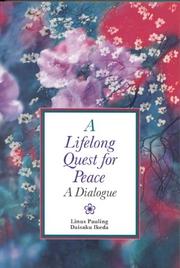 A Lifelong Quest for Peace1992
- 21Vitamin C & Cancer
 Vitamin C & Cancer2001
- 22Healing Cancer
 Healing Cancer2004
- 23Introduction to Quantum Mechanicswith Applications to Chemis
 Introduction to Quantum Mechanicswith Applications to Chemistry2018
- 24The Chemical BondThe Chemical Bond