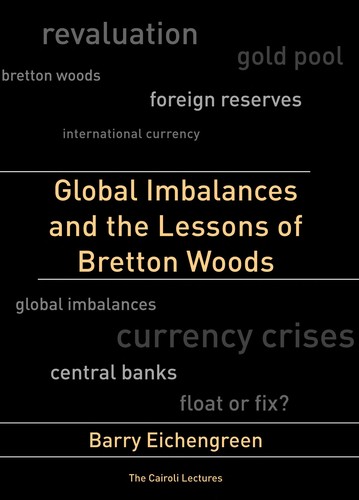
Global imbalances and the lessons of Bretton Woods
Première publication en 2004 · 113 pages
À propos de ce livre
"An influential school of thought views the current international monetary and financial system as Bretton Woods reborn. Today, like 40 years ago, the international system is composed of a core, which has the exorbitant privilege of issuing the currency used as international reserves, and a periphery, which is committed to export-led growth based on the maintenance of an undervalued exchange rate. In the 1960s, the core was the United States and the periphery was Europe and Japan. Now, with the spread of globalization, there is a new periphery, Asia, but the same old core, the United States, with the same tendency to live beyond its means. This view suggests that the current pattern of international settlements can be maintained indefinitely. The United States can continue running current account deficits because the emerging markets of Asia and Latin America are happy to accumulate dollars. There is no reason why the dollar must fall, since there is no need for balance of payments adjustment; in particular, the Asian countries will resist the appreciation of their currencies against the greenback. I argue that this image of a new Bretton Woods System confuses the incentives that confronted individual countries under Bretton Woods with the incentives that confronted groups of countries. It imagines the existence of a cohesive bloc of countries called the periphery ready and able to act in their collective interest.
- Currency question
- International finance
Livres comme Global imbalances and the lessons of Bretton Woods
Autres livres de Barry J. Eichengreen
 Exorbitant Privilege2012
 Golden fetters1992
 Globalizing Capital1998
 European monetary unification1997
 HALL OF MIRRORS2015
 The European Economy since 19452006
- The comparative performance of fixed and flexible exchange rate regimesThe comparative performance of fixed and flexible exchange rate regimes1989
 Elusive stability1990
 Sterling and the tariff, 1929-321981
- Emerging giantsEmerging giants2010
 Crisis? What crisis? Orderly workouts for sovereign debtors1995
 The gold standard in theory and history1985