
À propos de ce livre
"In this book, Michael G. Long offers a three-fold thesis to understanding King's understanding of the state. First, King adopted a theologically-based dialectical attitude towards the state. Second, King's theological understanding of the state remained constant in most of its fundamental elements but developed in substantive content and expression throughout his life.
Third, his view of the state has its roots in the African-American tradition he experienced through his family, church, and Morehouse professors, as well as in European-American religious and republic traditions. King's political thought was the result of a hardworking bricoleur, i.e., in the words of Stanley Hauerwas, "a strong moralist engaging in a kind of selective retrieval and reconfiguration of available moral languages for his own use."".
"King initially learned about the state not by reading Thomas Jefferson, Walter Rauschenbusch, Jacques Maritain, Karl Marx, or even Reinhold Niebuhr, but through his personal encounters with his Christian family, especially Daddy King, and with his Morehouse professors, especially the clergy-scholar Benjamin E. Mays.
The ultimate root of King's understanding of the state, Long concludes, is not in civic republicanism, theological liberalism, Marxism, Niebuhrian realism, or in any other such school, but in the religious tradition he experienced at home and at college."--BOOK JACKET.
- History
- Philosophy
- Political and social views
- Political science
- The State
- Politische Philosophie
- King, martin luther, jr., 1929-1968
- Political science, united states
Livres comme Against us, but for us
Autres livres de Michael G. Long
 Martin Luther King Jr., Homosexuality, and the Early Gay Rights Movement2012
 Christian peace and nonviolence2011
 Unstoppable2023
 Have the Time of Your Life2003
 Three Lines in a Circle2021
 Bayard Rustin2023
- Fight AIDS!Fight AIDS!2025
 Jackie Robinson2017
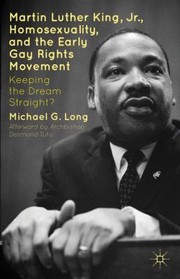 Martin Luther King Jr Homosexuality And The Early Gay Rights Movement Keeping The Dream Straight2012
- Phyllis Frye and the Fight for Transgender RightsPhyllis Frye and the Fight for Transgender Rights2022
 More Than a Dream2023
- Marshalling JusticeMarshalling Justice2011