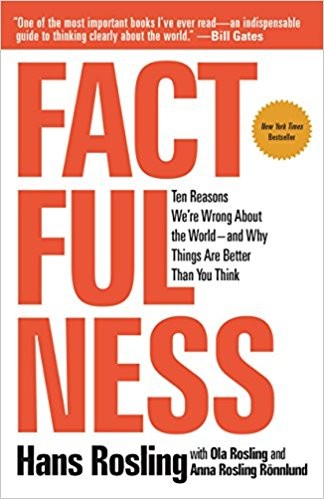
Factfulness review by Josh
Review by Josh100/100Read March 13, 2021
Factfullness is a good book. It builds on a lot of the work in heuristics and biases done by psychologists, economists, and philosophers over the past several decades to argue that people misunderstand the world in significant ways. More specifically, we generally have negative biases, failing to appreciate the massive global improvements in welfare.
A lot of the work on heuristics and biases is negative - focused on how they cause us to make mistakes in judgment and fail to see the world clearly. While such work is useful and interesting it’s often frustrating as well; it’s more or less impossible to eliminate the use of heuristics and biases - our brains are wired to use them and society and media are wired to take advantage of that so they’re unlikely to simply disappear anytime soon. One thing Rosling does very well is focusing on practical ways in ways in which we can replace our old heuristics that are better aligned with the way the world is.
For example: he argues that instead of dividing the world into the binary “Developed” and “Developing” world, we should divide the world into 4 levels based on much money per day people live on. L1 is <$1 per day; L2 = $1-$4 per day; L3 = $4-$16 per day; L4 = $16+ per day. As he points out from the perspective of someone making $200+ per day it many not look like there is a big difference between $1 a day and $4 per day, but from the perspective of the ~1 billion people currently living on under a dollar a day there is a huge difference (he goes into what those differences are - he also alerted me to the very interesting Dollar Street Project which has pictures of how people around the world live at different income levels: [Dollar Street - photos as data to kill country stereotypes](https://www.gapminder.org/dollar-street))
Two things irked me about the book: 1) There are a couple of places where he presents data that seems designed to make his claims appear even more dramatically correct than they actually are. One obvious example: There’s a passage where he’s talking about how deaths from war have steadily declined and to illustrate this he includes a chart with a line going pretty much straight down and to the left. The thing is the starting year for the chart is 1941 - the year in which the U.S. joined World War 2. His fundamental point, that death from war has declined significantly in recent times, is correct but this rather deceptive starting point makes it seems like a far less bumpy decline than it would be if he’d selected almost any other year. This is consistent with the generally upbeat bias of the book - while the authors make their case effectively they make the broad portrait of improvement seem less nuanced than it actually is.
2) In discussing the media he points out that our hunger for drama makes and narrative storytelling makes it basically impossible for the media to accurately convey a factual portrait of how the world is. I take his point here, but at the same time, this view seems to make no distinction between say, Breitbart and The New York Times. They’re both subject to the same market logic to attract and retain an audience, both biased and convey a distorted picture of how the world is, etc. At a very high level of abstraction, this may be true, but it’s also clearly insane. I guess I would have liked for him to further explore what good journalism would look like.
Despite these two things I’m still giving the book 5 stars. The book is clearly written for a popular audience and trying to keep the book short and enjoyable - that’s a legitimate goal, but it’s also one that sometimes requires glossing over stuff/oversimplifying (especially when you’re trying to cover so much ground). Despite this, I felt like I learned some very useful things from the book - both facts and heuristics for thinking.