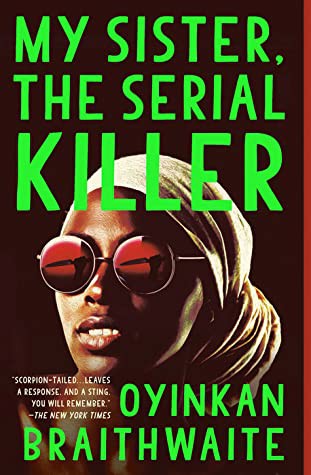
My sister, the serial killer review by Josh
My sister, the serial killer by Oyinkan Braithwaite
Review by Josh80/100Read September 21, 2026
This was a fun, fast-paced read—I finished it in a single evening.
The story is told in the first person by Korede, a nurse who lives in Lagos with her sister, the serial killer Ayoola.
These are boom times for stories about women burning with murderous rage. But unlike *The Housemaid*, *Promising Young Woman*, *Honey*, and *They Never Learn*, the men Ayoola kills are not particularly odious representatives of their sex.
The godmother of the genre is probably *Kill Bill* (Vol. 1 & 2), in which The Bride (Uma Thurman) goes on a murderous rampage after being grievously wronged by Bill and his gang. Bill's brother Budd admits that "that woman deserves her revenge... and we deserve to die." But then turns this into a darker, more existential point by laughing and adding, "but then again so does she."
In *Kill Bill*, though, The Bride's killings are not gender-specific. Of the five people on her hit list, three are women. The fact that the revival of the genre has focused so heavily on women getting revenge specifically on men probably doesn't represent an unambiguously positive development in gender relations.
Heather O'Neill, in her review, says the book "positions the deaths of shallow men as an acceptable sacrifice for women's actualisation. In this world men valuing women for their looks is seen as a form of brutality." This is an interesting reading, but I think it rests on fairly tenuous textual grounds: reconstructing sociopathic tendencies as a political statement.
There's an interesting passage where Korede gives her sister grief about a recent killing.
> "This is victim shaming, you know..."
Ayoola thinks:
> "Victim? Is it mere coincidence that Ayoola has never had a mark on her, from any of these incidents with these men; not even a bruise?"
O'Neill's interpretation is one way to resolve this: if being valued solely for your looks is itself a form of brutality, then perhaps Ayoola is a victim.
It's hard to imagine a publisher touching this book with the genders reversed. The protagonist is a rich, handsome, but not particularly bright or interesting man. He feels - rightly - that women are only interested in him for his looks and money, and he murders them as a means of achieving self-actualization.
One obvious reply women might give to explain the discrepancy would be to quote Chuck D "I got a right to be hostile, man, my people are being persecuted!" As campaigners against femicide have sought to illustrate women are actually being murdered in large numbers for their sex. Men are murdered in far greater absolute numbers, but it's for other reasons. If, in the next few years a wave of actual vigilante women emerges killing men en masse then perhaps the time will come for a reappraisal of these works. Or perhaps men will give a collective shrug and quote Budd, "we deserve to die"