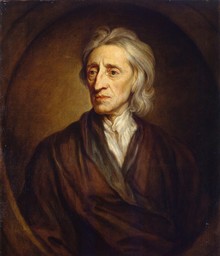
John Locke
Naissance 29 August 1632 · Décès 28 October 1704
John Locke, largement connu sous le nom de père du libéralisme, fut un philosophe et médecin anglais, considéré comme l'un des penseurs les plus influents des Lumières. Regardé comme le premier des empiristes britanniques, il occupe une place tout aussi importante dans la théorie du contrat social. Son œuvre a profondément marqué le développement de l'épistémologie et de la philosophie politique. Ses écrits ont influencé Voltaire et Rousseau, de nombreux penseurs des Lumières écossaises, ainsi que les révolutionnaires américains. Sa contribution au républicanisme classique et à la théorie libérale se reflète dans la Déclaration d'indépendance américaine.
La théorie de l'esprit de Locke est souvent citée comme l'origine des conceptions modernes de l'identité et du moi, et elle occupe une place centrale dans l'œuvre de philosophes ultérieurs comme Hume, Rousseau et Kant. Locke fut le premier à définir le moi par la continuité de la conscience. Il postulait que l'esprit est une table rase, une tabula rasa. Contrairement à la philosophie cartésienne qui l'avait précédée, il soutenait que nous naissons sans idées innées et que la connaissance ne se détermine que par l'expérience issue de la perception sensible.
Citations
“No man's knowledge here can go beyond his experience.”
An Essay Concerning Human Understanding, Book IIEn anglais “Good and evil, reward and punishment, are the only motives to a rational creature: these are the spur and reins whereby all mankind are set on work, and guided.”
Some Thoughts Concerning EducationEn anglais “We are all a sort of camelions, that still take a tincture from things near us; nor is it to be wonder'd at in children, who better understand what they see than what they hear.”
Some Thoughts Concerning EducationEn anglais “It is one thing to show a man that he is in error, and another to put him in possession of the truth.”
An Essay Concerning Human Understanding, Book IVEn anglais “Thus parents, by humouring and cockering them when little, corrupt the principles of nature in their children, and wonder afterwards to taste the bitter waters, when they themselves have poison'd the fountain.”
Some Thoughts Concerning EducationEn anglais
Citations de Wikiquote (CC BY-SA 4.0), choisies avec l'IA.
Les livres de John Locke dans l'ordre
Les livres de John Locke dans l'ordre de parution, de Du gouvernement civil (1689) à Two Treaties of Government (Annotated) (2021).
- 1Du gouvernement civil
 Du gouvernement civil1689
- 2Essai Philosophique Concernant L'entendement Humain
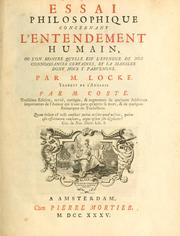 Essai Philosophique Concernant L'entendement Humain1689
- 3Lettre sur la tolérance
 Lettre sur la tolérance1689
- 4Deuxieme traité du gouvernement civil
 Deuxieme traité du gouvernement civil1691
- 5De L'education Des Enfans
 De L'education Des Enfans1693
- 6The Reasonableness of Christianity, as Delivered in the Scri
 The Reasonableness of Christianity, as Delivered in the Scriptures1695
- 7A Common-place Book to the Holy Bible
 A Common-place Book to the Holy Bible1697
- 8The Works of John Locke
 The Works of John Locke1714
- 9A Collection of Several Pieces of Mr. John Locke
 A Collection of Several Pieces of Mr. John Locke1720
- 10Que la religion chrétienne est très-raisonnable, telle qu'el
 Que la religion chrétienne est très-raisonnable, telle qu'elle nous est représentée dans l'Ecriture Sainte1740
- 11The Conduct of the Understanding
 The Conduct of the Understanding1781
- 12The Philosophical Works of John Locke
 The Philosophical Works of John Locke1843
- 13Philosophical Works
 Philosophical Works1854
- 14Of the Conduct of the Understanding
 Of the Conduct of the Understanding1859
- 15Two Treatises on Civil Government
 Two Treatises on Civil Government1884
- 16Locke's Travels in France, 1675-1679
 Locke's Travels in France, 1675-16791953
- 17Essays on the Law of Nature
 Essays on the Law of Nature1954
- 18The Second Treatise on Civil Government (Great Books in Phil
 The Second Treatise on Civil Government (Great Books in Philosophy)1956
- 19John Locke's Of the Conduct of the Understanding
 John Locke's Of the Conduct of the Understanding1966
- 20Two Tracts on Government
 Two Tracts on Government1967
- 21An Essay Concerning Human Understanding, 1690
 An Essay Concerning Human Understanding, 16901970
- 22The Empiricists
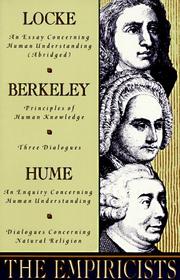 The Empiricists1974
- 23Political Writings
 Political Writings1993
- 24Two Treaties of Government (Annotated)Two Treaties of Government (Annotated)2021