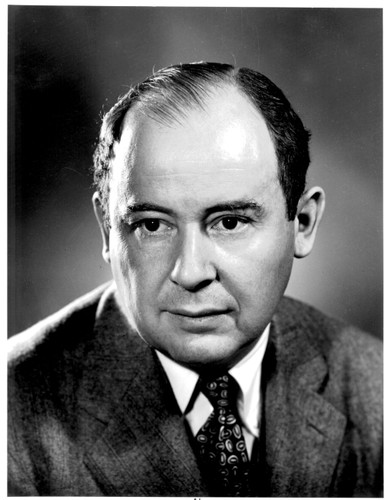
John Von Neumann
Born 1903 · Died 1957
John von Neumann (Hungarian: margittai Neumann János Lajos) was a Hungarian American[1] mathematician who made major contributions to a vast range of fields,[2] including set theory, functional analysis, quantum mechanics, ergodic theory, continuous geometry, economics and game theory, computer science, numerical analysis, hydrodynamics (of explosions), and statistics, as well as many other mathematical fields. He is generally regarded as one of the foremost mathematicians of the 20th century. The mathematician Jean Dieudonné called von Neumann "the last of the great mathematicians." Even in Budapest, in the time that produced Szilárd (1898), Wigner (1902), and Teller (1908) his brilliance stood out. Most notably, von Neumann was a pioneer of the application of operator theory to quantum mechanics, a principal member of the Manhattan Project and the Institute for Advanced Study in Princeton (as one of the few originally appointed), and a key figure in the development of game theory and the concepts of cellular automata and the universal constructor. Along with Edward Teller and Stanislaw Ulam, von Neumann worked out key steps in the nuclear physics involved in thermonuclear reactions and the hydrogen bomb.
Source: Goodreads
Quotes
“The sciences do not try to explain, they hardly even try to interpret, they mainly make models. By a model is meant a mathematical construct which, with the addition of certain verbal interpretations, describes observed phenomena. The justification of such a mathematical construct is solely and precisely that it is expected to work.”
p. 157 “With four parameters I can fit an elephant, and with five I can make him wiggle his trunk.”
p. 297 “Young man, in mathematics you don't understand things. You just get used to them.”
p. 208 “If people do not believe that mathematics is simple, it is only because they do not realize how complicated life is.”
p. 694 “It is just as foolish to complain that people are selfish and treacherous as it is to complain that the magnetic field does not increase unless the electric field has a curl. Both are laws of nature.”
p. 261
Quotes from Wikiquote (CC BY-SA 4.0), chosen with AI.
Books by John Von Neumann in order
Books by John Von Neumann in the order they were published, from Mathematical Foundations of Quantum Mechanics (1932) to John Von Neumann Selected Letters (2005).
- 1Mathematical Foundations of Quantum Mechanics
 Mathematical Foundations of Quantum Mechanics1932
- 2Functional OperatorsFunctional Operators1935
- 3Oblique Reflection of ShocksOblique Reflection of Shocks1943
- 4Theory of Games and Economic Behavior
 Theory of Games and Economic Behavior1944
- 5Theory of Games and Economic Behaviour
 Theory of Games and Economic Behaviour1944
- 6First Draft of a Report on the EDVAC
 First Draft of a Report on the EDVAC1945
- 7Functional Operators, Volume 1
 Functional Operators, Volume 11950
- 8Functional Operators, Volume 2
 Functional Operators, Volume 21950
- 9The Computer and the Brain
 The Computer and the Brain1958
- 10Collected WorksCollected Works1961
- 11John Von NeumannJohn Von Neumann1961
- 12The Collected Works of John Von NeumannThe Collected Works of John Von Neumann1963
- 13Theory of Self-reproducing Automata
 Theory of Self-reproducing Automata1966
- 14Continuous Geometries with a Transition Probability
 Continuous Geometries with a Transition Probability1981
- 15Papers of John Von Neumann on Computers and Computing Theory
 Papers of John Von Neumann on Computers and Computing Theory1986
- 16Neumann János És a "Magyar Titkok"Neumann János És a "Magyar Titkok"1987
- 17The Neumann Compendium
 The Neumann Compendium1995
- 18Continuous Geometry
 Continuous Geometry1998
- 19Invariant Measures
 Invariant Measures1999
- 20John Von Neumann Selected Letters
 John Von Neumann Selected Letters2005
- 21John Von Neumann PapersJohn Von Neumann Papers
- 22Lectures on Probabilistic Logics and the Synthesis of ReliabLectures on Probabilistic Logics and the Synthesis of Reliable Organisms from Unreliable Components