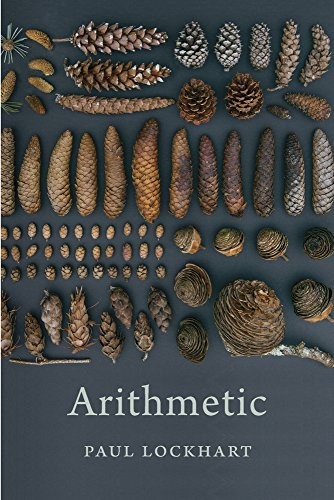
Arithmetic
First published 2017 · 240 pages · about 4 hours to read
Also as Kindle · AudiobookFind in a library
About this book
Educator Paul Lockhart's goal is to demystify arithmetic: to bring the subject to life in a fun and accessible way, and to reveal its profound and simple beauty, as seen through the eyes of a modern research mathematician. The craft of arithmetic arises from our natural desire to count, arrange, and compare quantities. Over the centuries, humans have devised a wide variety of strategies for representing and manipulating numerical information: tally marks, rocks and beads, marked-value and place-value systems, as well as mechanical and electronic calculators. Arithmetic traces the history and development of these various number languages and calculating devices and examines their comparative advantages and disadvantages, providing readers with an opportunity to develop not only their computational skills but also their own personal tastes and preferences. The book is neither a training manual nor an authoritative history, but rather an entertaining survey of ideas and methods for the reader to enjoy and appreciate. Written in a lively conversational style, Arithmetic is a fun and engaging introduction to both practical techniques as well as the more abstract mathematical aspects of the subject.--
Will you like it?
Readers who enjoyed school maths but want to see why it works will find this short book useful. It suits people curious about how counting systems, from tally marks to place value and calculators, shaped the way we calculate today.
- number systems
- history of counting
- calculating tools
- the beauty of arithmetic
Written with AI.
Books like Arithmetic
Zero
Charles Seifeabout 4 hours to read
It follows a single number concept through history and shows how it changed mathematics and thinking.
The Universal History of Numbers
Georges Ifrahabout 9 hours to read
It is a broad survey of how different cultures wrote and calculated with numbers, from ancient counting to computers.
The Measure of Reality
Alfred W. Crosbyabout 4 hours to read
It traces how Western societies came to think in numbers and measurement, linking mathematics to everyday practice.
Professor Stewart's Cabinet of Mathematical Curiosities
Ian Stewartabout 5 hours to read
It collects short, playful essays on mathematical ideas written for curious general readers.
More
Number
Tobias Dantzigabout 6 hours to read
It explains how the number concept developed and why mathematics is built on it, in a clear and historical style.
What Counts
Brian Butterworthabout 7 hours to read
It looks at how the human mind handles counting and number, and what that means for learning arithmetic.
An Imaginary Tale
Paul J. Nahinabout 4 hours to read
It tells the history of one strange number idea and the people who argued over it, with clear explanations of the mathematics.
Flatland
Edwin Abbott Abbottabout 2 hours to read
It uses a playful narrative to make geometric and dimensional ideas easy to picture for a general reader.
Quick answers
- What age is Arithmetic for?
- Adults.
- Is Arithmetic a standalone?
- Yes, it stands on its own.
- Does Arithmetic have violence, sex or strong language?
- Nothing a reader needs warning about.
Written with AI from what's known about the book.
Reader's guide
Themeshow number systems work, counting and representation, the beauty of arithmetic, tools for calculation, personal taste in methods
how number systems work · counting and representation · the beauty of arithmetic · tools for calculation · personal taste in methods
StyleLively, informal and conversational, written in the voice of a working mathematician who is also a teacher. It is short, about 240 pages, and mixes historical examples with hands-on methods. It is meant to be read for enjoyment, not as a training manual or a complete history.
Lively, informal and conversational, written in the voice of a working mathematician who is also a teacher. It is short, about 240 pages, and mixes historical examples with hands-on methods. It is meant to be read for enjoyment, not as a training manual or a complete history.
How it was writtenPaul Lockhart is a mathematician and educator, known for his earlier essay "A Mathematician's Lament" (2009), which criticised how mathematics is taught in schools. Arithmetic was published in 2017 by Harvard University Press's Belknap imprint. It is one of his books for general readers.
Paul Lockhart is a mathematician and educator, known for his earlier essay "A Mathematician's Lament" (2009), which criticised how mathematics is taught in schools. Arithmetic was published in 2017 by Harvard University Press's Belknap imprint. It is one of his books for general readers.
How it was receivedReaders have generally treated it as a provocative and enjoyable argument for thinking about arithmetic as a subject with real ideas behind it, not only a set of procedures. It is often recommended to adults who want to revisit school mathematics and to teachers.
Readers have generally treated it as a provocative and enjoyable argument for thinking about arithmetic as a subject with real ideas behind it, not only a set of procedures. It is often recommended to adults who want to revisit school mathematics and to teachers.
Questions to discussWhich number system would you choose for everyday work, and why?
These may talk about the whole book.
- Which number system would you choose for everyday work, and why?
- Does learning the history of a calculation method change how you understand it?
- What does Lockhart mean by arithmetic as a matter of taste and preference?
- How do place-value systems change what is easy and hard to compute?
- Why might teachers and students see arithmetic differently after reading this book?
Written with AI from what's known about the book.
More by Paul Lockhart
- Mending of Broken BonesMending of Broken Bones2025
- MeasurementMeasurement2012
- A Mathematician's LamentA Mathematician's Lament2009
Parts of this page are written with AI from what's known about the book, and can get details wrong. How BookSense works