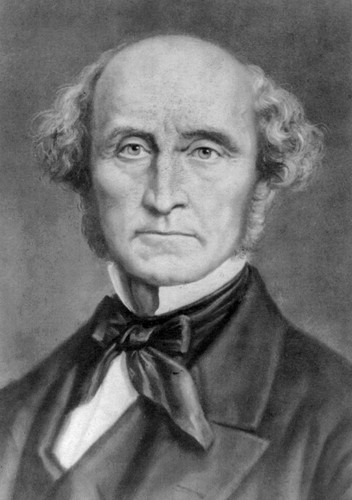
John Stuart Mill
Born 20 May 1806 · Died 8 May 1873
From Pentonville, England, United Kingdom · Nationality: United Kingdom of Great Britain and Ireland · Writes nonfiction
John Stuart Mill (20 May 1806 – 8 May 1873), usually cited as J. S. Mill, was a British philosopher, political economist, and civil servant. One of the most influential thinkers in the history of liberalism, he contributed widely to social theory, political theory, and political economy. Dubbed "the most influential English-speaking philosopher of the nineteenth century", Mill's conception of liberty justified the freedom of the individual in opposition to unlimited state and social control.
Source: John Stuart Mill on Wikipedia.
Millbot: a John Stuart Mill AI
Talk with Millbot, an AI that answers as John Stuart Mill, in his voice, from his books. It reads the full text of 10 of his books from Project Gutenberg, and the 1873 memorial sketches by Herbert Spencer, Henry Fawcett and others, and John Morley's essays on his death and his Autobiography. Words in quotation marks are truly his, with the book and chapter.
Millbot
Loading…
Quotes
“It is better to be a human being dissatisfied than a pig satisfied; better to be Socrates dissatisfied than a fool satisfied.”
Utilitarianism, Chapter 2 “It is not because men’s desires are strong that they act ill; it is because their consciences are weak.”
On Liberty 1859 “Human nature is not a machine to be built after a model, and set to do exactly the work prescribed for it, but a tree, which requires to grow and develop itself on all sides, according to the tendency of the inward forces which make it a living thing.”
On Liberty, Chapter III “A pupil from whom nothing is ever demanded which he cannot do never does all he can.”
Autobiography, p. 32
Quotes from Wikiquote (CC BY-SA 4.0).
Books by John Stuart Mill in order
Books by John Stuart Mill in the order they were published, from A System of Logic, Ratiocinative and Inductive (1843) to John Stuart Mill (2018).
- 1A System of Logic, Ratiocinative and Inductive
 A System of Logic, Ratiocinative and Inductive1843
- 2A System of Logic
 A System of Logic1846
- 3Principles of Political Economy
 Principles of Political Economy1848
- 4Dissertations and Discussions
 Dissertations and Discussions1859
What's in it (12)
- The Right and Wrong of State Interference with Corporation and Church Property
- The Currency Juggle
- A Few Obsevations on the French Revolution
- Thoughts on Poetry and Its Varieties
- Professor Sedgwick's Discourse on the Studies of the University of Cambridge
- Civilization
- Aphorisms: A Fragment
- Armand Carrel
- A Prophecy
- Writings of Alfred De Vigny
- Bentham
- Coleridge
- 5On Liberty
 On Liberty1859
- 6Considerations on Representative Government
 Considerations on Representative Government1861
- 7Utilitarianizm
 Utilitarianizm1863
- 8Auguste Comte and Positivism
 Auguste Comte and Positivism1865
- 9Collected Works
 Collected Works1869
- 10The Subjection of Women
 The Subjection of Women1869
- 11On Liberty; The Subjection of Women
 On Liberty; The Subjection of Women1873
- 12The Autobiography of John Stuart Mill
 The Autobiography of John Stuart Mill1873
- 13Nature, the Utility of Religion, and Theism
 Nature, the Utility of Religion, and Theism1874
- 14The Basic Writings of John Stuart Mill
 The Basic Writings of John Stuart Mill2002
- 15Sobre La Libertad
 Sobre La Libertad2008
- 16J.S. Mill
 J.S. Mill2010
- 17Later Letters of John Stuart Mill 1849-1873Later Letters of John Stuart Mill 1849-18732017
- 18John Stuart Mill
 John Stuart Mill2018
- 19Chapters on Socialism
 Chapters on Socialism
- 20John Stuart Mill on Politics and Society
 John Stuart Mill on Politics and Society
- 21Utilitarianism, On Liberty, and Essay on Bentham
 Utilitarianism, On Liberty, and Essay on Bentham