
Thomas Hobbes
Born 5 April 1588 · Died 4 December 1679
From Westport, England, United Kingdom · Nationality: Kingdom of England · Writes nonfiction
Thomas Hobbes, in some older texts Thomas Hobbs of Malmsbury, was an English philosopher, remembered today for his work on political philosophy. His 1651 book Leviathan established the foundation for most of Western political philosophy from the perspective of social contract theory.
Hobbes also contributed to a diverse array of fields, including history, geometry, physics of gases, theology, ethics, general philosophy, and political science. His account of human nature as self-interested cooperation has proved to be an enduring theory in the field of philosophical anthropology. He was one of the main philosophers who founded materialism.1
Quotes
“The passion of laughter is nothing else but a sudden glory arising from sudden conception of some eminency in ourselves, by comparison with the infirmities of others, or with our own formerly...”
Quote, Chapter 9 “For there is no such thing as perpetual Tranquility of mind, while we live here; because Life it selfe is but Motion, and can never be without Desire, nor without Feare, no more than without Sense.”
Leviathan, Chapter 6 “As in the presence of the Master, the Servants are equall, and without any honour at all; So are the Subjects, in the presence of the Soveraign. And though they shine some more, some lesse, when they are out of his sight; yet in his presence, they shine no more than the Starres in presence of the Sun.”
Leviathan, Chapter 18 “The first cause of Absurd conclusions I ascribe to the want of Method; in that they begin not their Ratiocination from Definitions; that is, from settled significations of their words: as if they could cast account, without knowing the value of the numerall words, one, two, and three.”
Leviathan, Chapter 5 “So that every Crime is a sinne; but not every sinne a Crime.”
Leviathan, Chapter 27
Quotes from Wikiquote (CC BY-SA 4.0).
Books by Thomas Hobbes in order
Books by Thomas Hobbes in the order they were published, from Hobbes's Leviathan (1651) to Leviathan by Thomas Hobbes (2020).
- 1Hobbes's Leviathan
 Hobbes's Leviathan1651
- 2Elements of Philosophy, the First Section, Concerning Body
 Elements of Philosophy, the First Section, Concerning Body1656
- 3The Questions Concerning Liberty, Necessity, and Chance
 The Questions Concerning Liberty, Necessity, and Chance1656
- 4Behemoth
 Behemoth1680
- 5Considerations upon the Reputation, Loyalty, Manners, & Reli
 Considerations upon the Reputation, Loyalty, Manners, & Religion of Thomas Hobbes of Malmsbury1680
- 6Of Man
 Of Man2005
- 7Reason of State, Propaganda, and the Thirty Years' War
 Reason of State, Propaganda, and the Thirty Years' War2007
- 8The Essential Leviathan
 The Essential Leviathan2016
- 9Leviathan by Thomas HobbesLeviathan by Thomas Hobbes2020
- 10A Dialogue Between a Philosopher and a Student of the Common
 A Dialogue Between a Philosopher and a Student of the Common Laws of England
- 11An Answer to a Book Published by Dr. Bramhall, Late Bishop oAn Answer to a Book Published by Dr. Bramhall, Late Bishop of Derry; Called the Catching of the Leviathan. Together with an Historical Narration Concerning Heresie, and the Punishment Thereof. By Thomas Hobbes of Malmesbury
- 12Body, Man, and Citizen
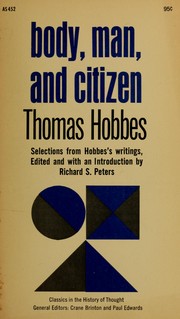 Body, Man, and Citizen
- 13De Cive
 De Cive
- 14Leviathan, Parts One and Two
 Leviathan, Parts One and Two
- 15LeviathianLeviathian
- 16Man and Citizen
 Man and Citizen
- 17Man and Citizen. Hobbes' De Homine, Tr by C.T. Wood
 Man and Citizen. Hobbes' De Homine, Tr by C.T. Wood
- 18Selections
 Selections
- 19The Elements of LawThe Elements of Law
- 20The Elements of Law, Natural and Politic
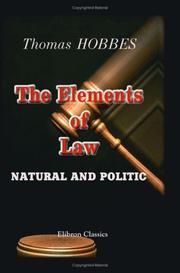 The Elements of Law, Natural and Politic
- 21The English Works of Thomas Hobbes of Malmesbury
 The English Works of Thomas Hobbes of Malmesbury
- 22The Ethics of Hobbes
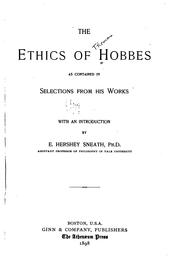 The Ethics of Hobbes
- 23The Metaphysical System of Hobbes
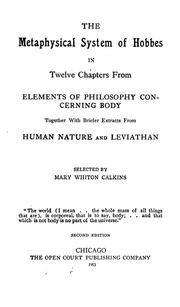 The Metaphysical System of Hobbes